Refugees Welcome at the U.S Supreme Court, U.S. Capitol, & Martin Luther King Memorial!

U.S Supreme Court, Washington, D.C- Friday, April 8th- 10:30am


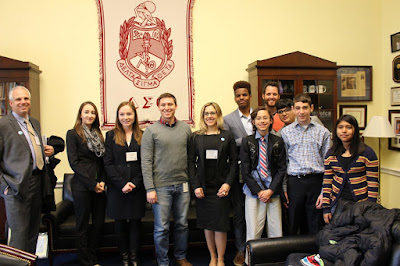
U.S. Capitol, Washington, D.C- Friday, April 8th- 10:45am


Martin Luther King Memorial, Washington, D.C- Friday, April 8th- 11:30am

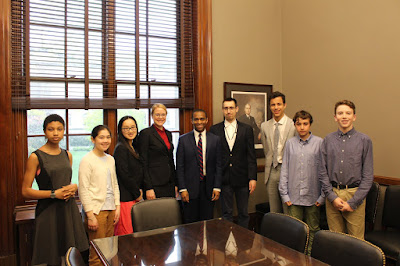
MCS students meet with Refugee Council U.S.A and the Center for American Progress


Naomi Steinberg, director of Refugee Council U.S.A, and Tom Jawetz, the Vice President of Immigration Policy at the Center for American Progress, met with Students on Friday to share their perspectives on the Syrian refugee crisis and to explain how their organizations are involved in advocating for the rights of refugees. There was also space for students to share their experiences lobbying with Congress. 

The Center for American Progress is an independent non partisan policy institute that is dedicated to improving the lives of all Americans, through bold, progressive ideas, as well as strong leadership and concerted action. They develop new policy ideas, challenge the media to cover the issues that truly matter, and shape the national debate.

Refugee Council U.S.A is a coalition of U.S non-governmental organizations focused on refugee protection. Refugee Council U.S.A provides advocacy on issues affecting the rights of refugees, asylum seekers, displaced persons, victims of trafficking, and victims of torture in the United States and across the world. 

Our last day in Washington D.C

Breakfast at "Lincoln's Waffle Shop"
A break to play "taps" 
These shoes in front of the Supreme Court represent the children who have walked across the U.S.-Mexico border and are waiting for the court's decision in United States vs. Texas to determine whether Obama's executive orders (DACA and DAPA) will be implemented.

To learn more check out these two articles:
Will the U.S. Supreme Court Tell Obama to 'Take Care'?
Everything you need to know about the Supreme Court challenge to Obama's immigration policies

Making the most of our time in D.C.

Washington, D.C. - April 7 - 10pm


MCS Activists join the American Immigration Lawyers Association's Day of Action on Capitol Hill

Washington, D.C. - April 7 - 5pm


"We'd like the representative to oppose the SAFE act, which lengthens the process for refugees to apply for asylum. We'd also like you to oppose the HR 4731Refugee Program Integrity Restoration Act, which gives the government the power to defund certain refugee resettlement agencies" (Carolina, 7th grade)


"We'd also like people in congress to speak out against Islamophobia and bigotry against muslims and refugees…they already have a tough life fleeing terrorism and oppressive government."(Vidar, 8th grade)


7th & 8th graders meet with KARAMAH: Muslim Women Lawyers for Human Rights

Washington, D.C. - Wednesday, April 6 - 4pm

KARAMAH: Muslim Women Lawyers for Human Rights is  a nonprofit organization committed to promoting human rights globally, especially gender equity, religious freedom and civil rights in the United States. It pursues its mission through education, legal outreach and advocacy. 

Aisha Rahman, executive director of KARAMAH and head of the organizations Family Law Division gave a brief overview of the organizations work engaging students in a case study.


She concluded by offering suggestions for how to counter some of the big misconceptions about muslims, and specifically muslim women, circulating in the media.

Refugees Welcome at the Washington Monument!

Washington, D. C. - Wednesday, April 6 - 5:45pm

MCS Students speak out in Washington.. and are joined by Iranian-American Comedian Maz Jobrani in front of the White House!

Washington, D.C. - Wednesday, April 6 - 5:30pm
Many people were interested in our banner in front of the White House, including Maz Jobrani.


Iranian-American comedian Maz Jobrani joined in support of the 5th floor activism campaign.

MCS Activists depart for Washington

NEW YORK CITY - Wednesday, April 8: 8am

We called our representatives to oppose H.R. 4731 - will you please call, too?

On Tuesday, the Manhattan Country School eighth graders made calls to the House Judiciary Committee urging them to oppose H.R. 4731, also known as “The Refugee Program Integrity Restoration Act.”. Despite its misleading name, this bill allows states to decline any refugees who are seeking asylum to enter said state. We encourage you to call your district representative and say that you want to help welcome refugees and that you urge them to reject H.R. 4731.

According to human rights first, H.R. 4731 would dismantle the refugee resettlement system’s integrity by:


  • Drastically reducing the number of refugees the United States resettles annually.
  • Changing the definition of a refugee to make it harder for many of the most vulnerable victims of mass atrocities to receive protection.
  • Allow state and local authorities to veto refugee resettlement in their areas, undermining constitutionally designated federal authority.
  • Force refugees to re-prove their status three years after arrival, potentially re-traumatizing them and wasting government resources.

National security leaders agree that it is in U.S. national security interests to resettle refugees. Failing to do so undermines counterterrorism efforts and increases the strain on front-line states. Refugees are extensively vetted—more than any other group or individual entering the United States. Most importantly, this bill represents an abdication of the United States’ historic role as a leader in refugee resettlement. To send a message to your representative through click here.

MCS hosts visitors from the Arab American Association

This Tuesday MCS hosted two activists from the Arab American Association, Mirna Haidar and Aber Kawas. They shared their experiences as part of the muslim community in New York City, breaking down the impact of islamophobia on muslims and people who look like muslims.  We also learned about the NYPD surveillance program of the muslim community and the Arab American Association's work to stop the program.

"It's unfair that when people see muslims or people who look like muslims they automatically think of terrorists." - Sherman

"The biggest takeaway is that the NYPD and many of our institutions are far more prejudiced toward the muslim community than I thought or could have imagined.  People are being taken advantage of and used to spy on friends and neighbors... and it's covered up.  I hadn't even heard about it before. The fact that these things are going on in the 21st century is appalling.  It is upsetting how in a very open place like New York people are still so easily controlled by stereotypes and that how you look and what you wear can so deeply affect how you're treated.  I was also struck by the fact that people are fleeing violence only to come to more persecution. Mirna told us that bombs had less of an emotional impact on her than what she experiences here.  " - Liam

View the ACLU Fact Sheet on NYPD muslim surveillance
Read about the ACLU court challenge to NYPD surveillance of the muslim community
Mirna's Story - a human rights activist from Lebanon discusses asylum in NYC

MCS Activists reflect on "Beyond Sacred: Voices of Muslim Identity"

On February 7th several MCS Activists attended a performance at the New School entitled Beyond Sacred: Voices of Muslim Identity, an interview-based theatre production by Ping Chong + Company. Exploring the diverse experiences of Muslim communities within New York City, the young participants in Beyond Sacred share the common experience of coming of age in a post-9/11 NYC. The goal of Beyond Sacred is to use theater and personal testimony to foster greater understanding among Muslim and non-Muslim communities in New York and beyond.

"It was really interesting to hear all of the personal stories.  Hearing stories from people who've struggled with islamophobia for their whole lives made it apparent that the problem is much bigger than a one-time thing in the news." -Ayla

"There were five people sharing the voices of many people who'd submitted stories. They talked about how people started to judge people wearing hijabs and how all muslims are blamed for things that have happened that they did not all agree to.  Even five year olds and ten year olds are being mistreated at school." - Jessica

MCS Activists impressed by Islamic Art Exhibit at the Metropolitan Museum of Art


"When we decided that our activism topic this year would be aid to Syrian refugees and fight against Islamophobia, we also came to the realization that ignorance of the principles and culture of Islam is a driving force behind Islamophobia. To educate others on Islam, however, we would need to educate ourselves on it. Our first activism-related field trip this year was to The Metropolitan Museum of Art, where we spent a morning inside the museum’s “Islamic Art” exhibit. The first thing I saw when I entered the gallery was a beautiful ceramic bowl that had a phrase on it in Arabic in a powerful, elegant font. I later learned that it read, "Planning before work protects you from regret; prosperity and peace.” I began to notice other pieces that had writing on them, such as the stunning Damascus Room. The Damascus Room is a reception chamber thought to have belonged to an affluent family in the 18th century. It had poetry on its walls and ceiling, and the floor was comprised of complex tile patterns. It was my favorite piece in the entire exhibit. I learned that writing, whether it be of proverbs or the Qur’an, is a huge part of Islamic culture and art." - Kenji

"I saw many beautiful works of art, including intricate carpets and weavings as well as many geometric patterns used in various works of art. It surprised me how complex, but also simplistic each pattern is. I felt mesmerized by the art while I was there because it was so unique. The exhibit has taught me about Islamic culture and art, something I had previously not known much about." - Sophia

"Our activism project for this year is the Syrian refugee crisis.  Right now, we are just learning about the ongoing crisis and about Islamic culture.  To gain a better understanding of Islamic culture, we went to the Metropolitan Museum of Art and observed the exhibit on Islamic art.   The art shown there was stunningly beautiful.  Something that I found fascinating was that every single piece there, from small gold coins to giant tapestries, had geometric shapes and patterns all over it.  Also, my breath was taken away from all the intricate designs on the arches and the walls of the amazing Moroccan garden.  I was surprised by the level of detail on things even as small and seemingly basic as the hilt of a dagger.  I felt completely mind-blown while going to the museum because of all the beautiful art surrounding me.  My perception of Islam definitely changed by going on this trip.  I had never known that Muslim people put so much effort into making something as ordinary as a box or a tray so magnificent." - Jack

"I feel that the trip to the Met gave me a broader understanding of Islamic cultures... There is so much more to the Islamic states than war. There is beautiful art and design, and there are people with great knowledge..." - Matthew

"I think my favorite part of our activism project so far was the trip to see the collection of Islamic art at the MET. I was really amazed by the detailed replicas of different rooms and courtyards. We watched a video on how the replicas were made, and it was really crazy to see how they carve, cut, tile, and paint something as simple as a door, and make it look like a piece of art. I also really liked seeing the different versions of the Qur'an. They also incorporated writing into many other objects like plates and bowls. It was fun to try to copy some Arabic phrases that we saw around the exhibit. I really got a feeling of the religion and cultures from the art, and the displays." - Sophie

"When you make a piece of art you give people a piece of your heart. You can see at the Met that the artists spent a lot of time on these pieces of art. It made me think about the artists as living, breathing human beings." - Izzy

"Something that surprised me was how much detail went into art on objects to represent significance in that object. While I was looking at the art, I felt calm and glad in a way that I was able to learn about Islamic culture through art. This trip emphasized the fact that it is important to respect that every religion is unique." - Carolina

"I really enjoyed our trip to the MET’s exhibit on Islamic art. What struck me in particular was how different the art from different regions was. Since Islam is a religion practiced all throughout the world, there are different styles that the creators of the pieces use. For example, a water bird from a piece created in South East Asia is depicted very realistically, with its neck thin and stretched out; where as the same bird from a tapestry made on the Arabian peninsula would be embroidered in green and physically much more stocky. This may also be a symbol; the picture depicting the bird’s long neck could symbolize listening and understanding, while the bird shown in the tapestry might be a symbol of nature." - Aaron

"It was very interesting seeing all of the work in the Islamic Art section at the MET. I admired the small details on the pieces like the jewelry or the rooms. I especially liked the temple that had many detailed designs on the walls. The tapestries were very impressive as well because of the length and the detail. We learned a lot about the detail of the art and how it is a big part of Islamic cultures." - Anais

"I saw detailed Arabic engraved in almost every piece. The beautiful sculpting work was made by careful hands. They had lots of rugs on display, with so many designs that are impossible to count. Some things I saw I thought were just paintings, but when I looked closely, I saw lots of Arabic writing, that was written in shapes to make the design of the painting. I had a great time learning about the importance of Islamic art." - Jessica

"At the Met, I saw many different pieces of art and tools that people used many years ago... There was a device that looked like a modern grill and a gorgeous royal room that I nicknamed My Dream Living Room. There were also beautiful textiles and wonderful fountains and water features. I felt relaxed there at the Met, something a teenager doesn't feel quite often." - Matthew

MCS students call representatives to encourage the resettlement of Syrian refugees in New York

"The activism topic for the Fifth Floor this year is tackling Islamophobia and supporting Syrian refugees’ resettlement in America. To help, I decided to call the office of the New York Governor, Andrew Cuomo. My call was very interesting. I dialed the number and called Cuomo’s office and a woman picked up the phone. She asked me why I was calling, and I told her that I was calling to encourage the resettlement of Syrian refugees in New York. She asked me to hold on for a second. She then asked me, “Okay, you’re opposing the resettlement of refugees?” I corrected her and told her that I was supporting the resettling of refugees in New York and hung up the phone. After the call, it occurred to me why the woman had asked if I opposed resettlement of refugees. It was because she had received so many other calls that opposed Syrian refugee resettlement. At this point it became clear to me how large of a crowd we were fighting against, and how important our activism would be." - Alec

MCS students engage with the refugee intake process

"As of right now 12.8 million Syrians are in need of refuge, and half of current governors have said no to opening their doors to Syrians. So we (the fifth floor) decided to see what the actual process for applying for Asylum is like, and we discovered it isn’t an easy process at all. There’s a lot of questions and physical tests, that really don’t make you feel at ease. It’s a quite hectic and degrading cycle to go through.  They don’t care about who you are or your struggles; they just want to see if you're useful. I really felt like an object being tossed and played around with, and I felt that way being an American citizen myself, so I can only imagine that for someone who is foreign, who might not speak English, and is quite vulnerable, the process is far more traumatizing." - Amina

"One of the activities really stood out to me - it was about the process of applying for refugee status. We went through most of the steps of applying and it helped me visualize and understand what the process was actually like. It made me understand that this process is unfair, inhumane and degrading to the people going through it because they have to answer all of these questions they don’t know and they have to listen to everything someone says, because if they don’t they can easily be sent back. I think if we made this process simpler and more human it would create less anxiety and nerves for these poor refugees who have no safe place to go." - Pearl

"During the activity about what its like to apply for asylum (refugee status), I learned what it was like and how it felt. Of course, this could never compare to the real thing, but it gave as a sense of how hard it is to finally feel safe." - Julia

"Everyone in the class took part in an activity that was meant to resemble the process of applying for asylum as a Syrian refugee. We played out a very long process in a short amount of time. The difficulties in the process of applying to asylum isn’t given as much attention as whether or not countries decide to take in refugees. I was not aware of how long it took and how unreasonable some of the questions were. With such an extensive background check, refusal to take in refugees comes down to a stereotypical and Islamophobic mindset; two words that present a more accurate description of political leaders who do not want Syrian refugees in their country.  During the activity the overwhelming emotion I had was confusion. Many of the question were hard to understand.  After the activity was finished I realized how dehumanizing and degrading the process felt. There was no consideration for people’s stories or what they had been through. The questioners (teachers) were more concerned with what we could do to them rather than what could happen to us if we did not make it into asylum. This activity highlighted the importance of a story. A vital part of activism is sharing people’s stories to the world. Humanizing Syrian refugees should be an active part of our activism advocating for the resettlement of more refugees." - Ajani

In order to counter Islamophobia, we had to start by learning about Islam

"We have learned much about the past, how Islam came to be, and the many ways it shaped where we are now. I find this part particularly interesting because of the fact that most argue that Syrian refugees will not fit in, will not be accustomed to western culture, and do not belong here. But in reality, a lot of our culture is derived from Islam and those who were part of it. We have also learned much about the war in Syria, for example who’s fighting for what and why. It gave me a sense of what Syrian refugees were trying to escape, and why it was so important." - Julia

"One Friday we were all split up into 3 groups where we either learned about Muslim scientists, frame drumming and Arabic rhythms or art with geometry. I was put in the group where we learned about frame drumming and Arabic rhythms. Nassim showed us many rhythms on these drums which helped us get a taste of the cultures connection to drumming. I learned that many parties would involve a point where the band would hand out drums and everyone would start a rhythm. This would go on for hours and everyone had a good time. I think the point of this lesson was to show us that drums played in big role in this community and religion." - Jenna


"Ever since we started our Activism Campaign we have learned about: Organizations that do work with Syrian refugees, the truth about the Syrian civil war and the refugee crisis, Islam and what the Qur'an says, and the SAFE Act and what we can do to stop discrimination against Muslims. " - Marcelo

"This year for activism we are focusing on the Syrian refugee crisis and Islamophobia.  So far we have looked deeper into Islam's principles to become more aware about the foundation of the religion. We have seen Islamic art, talked about Mohamed and the pillars of Islam, and looked at the origins of Islamic regimes.  Islamophobia is a huge factor in why many Americans do not like the idea of taking in Syrian refugees to the United States.  Many Americans minds are clouded by fear and lies that all Muslims are terrorists.  This is a deplorable accusation that we are taking a stand against." - Osiris

"I have learned a tremendous amount about our activism topic this year. I have done everything from calling my elected representatives to persuade them to fight to take in more Syrian Refugees in the United States to learning about the Qur’an, Islamic art, and the prophet Mohammed. I have learned an incredible amount about the Syrian civil war and why refugees are leaving Syria in the first place. I have learned the difference between a refugee and an immigrant, and why it is so important to help refugees around the world. My triplet did a lesson on geometry and art in Islam, and I looked at some amazing drawings and tile patterns. In our recent trip to the Islamic art section of the Metropolitan Museum of Art, we learned about the global influence and history of Islam and how impactful their way of life has been in shaping the world as a means of countering Islamophobia. We have signed petitions of many influential human rights organizations and made phone calls to our members of Congress, Governor and the White House. We went through the ordeal of applying for refugee status, and how demoralizing a process that is. We have learned all of this in less than a month; I cannot wait to see how we will continue our project and I look forward to continue to learn and grow as an activist." - Cal

Did you know that...

  • Asylum seekers are vetted for at least 18 months.
  • If all refugees being accepted were Muslim then the Muslim minority in Europe would change by 1%. 
  • Germany is accepting 800,000 refugees, 80 times more than the amount the U.S. is accepting. 
  • Jihadist doesn’t mean “holy war,” it means a struggle to be a better person. 
  • Allahu Ackbar means “God is Great,” and does not imply violence.

About MCS Activism


MCSActivism is the official blog for the annual seventh and eighth grade activism project at Manhattan Country School. MCS is a pre-K through eighth-grade independent school in New york City that envisions its students as future leaders whose shared experiences in learning and activism inspire them to champion excellence and justice, compassion and peace, and the rights of all people to equity.

Tell Congress to Pass the Campus Accountability and Safety Act (CASA)!


Over the last few years, young activists have brought national attention to the issue of rape on campus. In response congress members have proposed the CASA Act to reform how universities respond to and report sexual assaults at their schools. Our students decided to advocate for this bill. For more information on the bill see here: http://www.gillibrand.senate.gov/campus-sexual-assault
This year we have partnered with postcard.com so that anybody can upload an image and a message and it will be turned into 3 actualpostcards that get mailed to our New York senators and the chair of the committee that will decide whether the Campus Accountability and Safety Act moves forward.  Please Watch their video promoting the campaign: https://www.youtube.com/watch?v=hksrzgCIrgU It's only a minute and a half. 

Then go to this link: http://postcard.com/join-a-movement/28 to make a postcard.  Each image you upload will become 3 postcards. 

Imagine when MCS students walk to the Senator's office and deliver hundreds of postcards with your messages on them! The more the merrier and if you know people who work on related issues please let them know.
Thank you and please spread the word!!!